Five Restaurants in Singapore Worth Experiencing
Singapore is a city that seems to understand food on a deeply personal level. Eating here is not simply about finding something delicious. It is about discovering stories, traditions, memories, cultures, and creativity through every meal. In a city where different communities have lived alongside one another for generations, food has become one of the most beautiful ways to experience what makes Singapore unique.
For visitors, choosing where to eat can sometimes feel overwhelming. There are countless restaurants, cafes, food centres, hawker stalls, and fine dining establishments spread across the city. Some places are famous because of their history, while others attract attention because of innovative chefs and carefully designed menus. There are also restaurants where the experience itself becomes a memory that stays with you long after you have left Singapore.
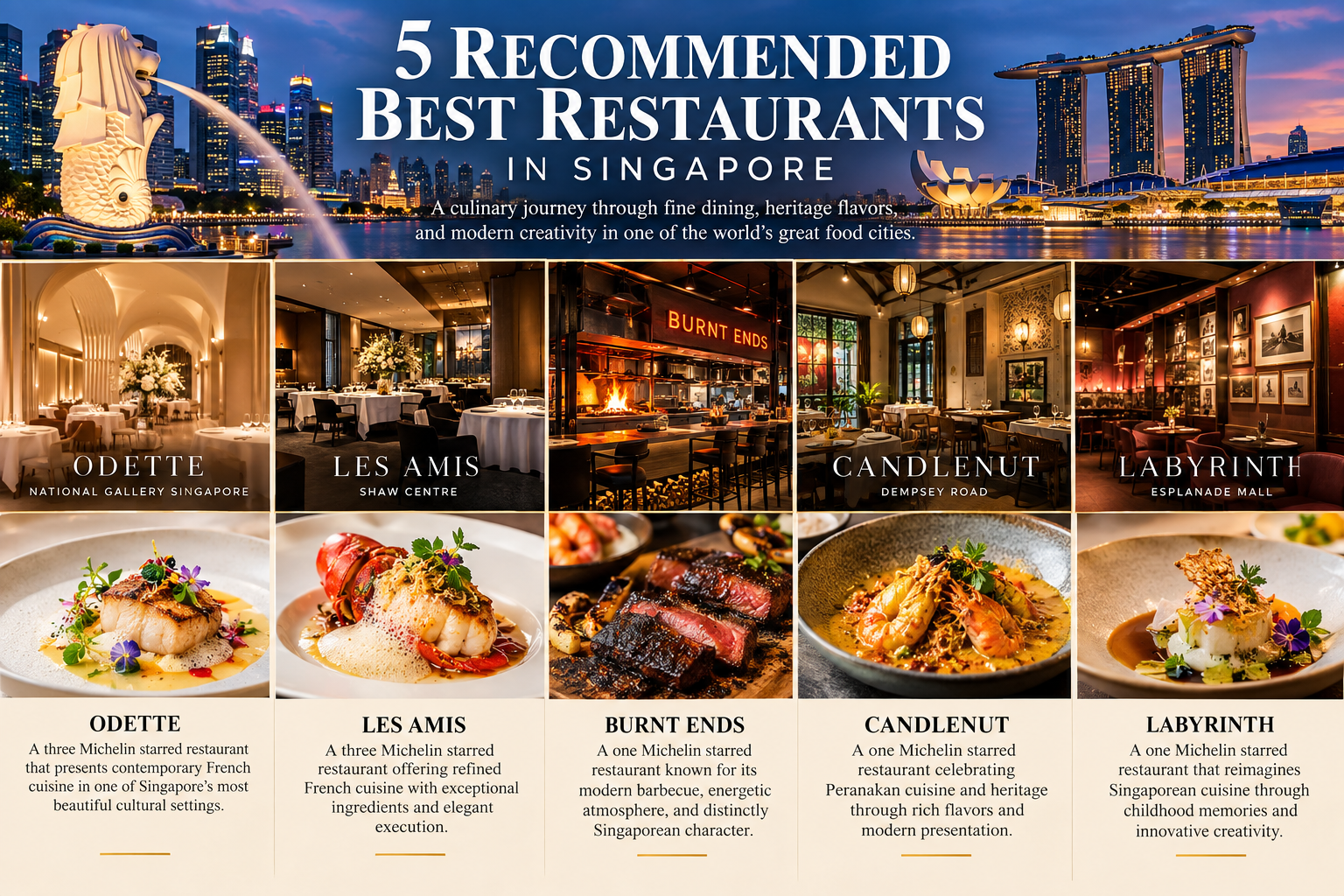
Among the many choices available, five restaurants stand out for offering very different interpretations of dining in Singapore. Odette brings contemporary French cuisine into one of the citys most beautiful cultural settings. Les Amis represents refined French dining with an emphasis on exceptional ingredients and carefully executed dishes. Burnt Ends presents a more relaxed and energetic approach through modern barbecue. Candlenut celebrates Peranakan food and heritage, while Labyrinth explores Singaporean cuisine through creativity and childhood memories.
These restaurants are not necessarily similar, and that is exactly what makes them interesting. Each one tells a different story about food. Some are formal and elegant. Others are warm, energetic, and contemporary. Together, they demonstrate why Singapore has developed such a strong reputation as a destination for people who genuinely love eating.
Odette
Located inside the National Gallery Singapore, Odette is one of the restaurants that immediately creates a sense of occasion. Even before the first dish arrives, the surroundings contribute to the feeling that the meal will be something special.
Odette serves contemporary French cuisine and is led by chef Julien Royer. The restaurant has retained three MICHELIN Stars in the 2026 Singapore selection, placing it among the three restaurants in Singapore holding the highest MICHELIN distinction. (MICHELIN Guide)
What makes Odette particularly memorable is the way food, presentation, and atmosphere come together. The restaurant does not treat food as something that simply needs to taste good. Each dish is presented with considerable attention to detail. The ingredients, textures, colours, and arrangement on the plate are carefully considered.
For someone experiencing Odette for the first time, this can make the meal feel almost like visiting an art exhibition. That connection feels especially appropriate because the restaurant is located within the National Gallery. The setting creates an atmosphere where dining becomes more than simply sitting down for lunch or dinner.
The cuisine is French in its foundation, but the experience does not feel stuck in the past. Contemporary techniques and creative combinations allow familiar ingredients to be presented in ways that can feel unexpected. The MICHELIN Guide describes the restaurant as combining creative combinations, precise technique, and elegant presentation. (MICHELIN Guide)
One of the things that makes a restaurant memorable is its ability to make guests slow down. Modern life often encourages people to eat quickly while checking their phones or thinking about their next appointment. A restaurant such as Odette creates the opposite feeling. The pace encourages guests to pay attention.
You notice the details. You look at the plate before taking the first bite. You consider the aroma. You discover different textures. You talk about the dish with the person sitting beside you. A meal becomes a shared experience rather than simply another activity during a busy day.
Odette is therefore particularly suitable for people celebrating an important occasion or travellers who want to dedicate part of their Singapore trip to an extraordinary dining experience.
It is also a restaurant for people who appreciate presentation and refinement. If your idea of a memorable meal involves beautifully composed dishes, elegant surroundings, attentive service, and sophisticated flavours, Odette can provide that kind of experience.
There is something deeply human about this style of dining. Behind every beautifully presented plate is a team of people who have spent years learning how ingredients behave, how flavours interact, and how small details can change an entire dish.
That attention is what guests ultimately experience.
Les Amis
Another restaurant that represents the highest level of Singapore dining is Les Amis. Located at Shaw Centre on Scotts Road, Les Amis has become a longstanding name in the citys fine dining scene.
Like Odette, Les Amis currently holds three MICHELIN Stars in the 2026 Singapore selection. (MICHELIN Guide)
The restaurant focuses on French cuisine and is associated with chef Sebastien Lepinoy. According to the MICHELIN Guide, the restaurant places significant emphasis on premium ingredients, with many products sourced from France. Its menus combine modern French classics with occasional Asian influences. (MICHELIN Guide)
The appeal of Les Amis lies partly in its sense of confidence. There is no need to make the experience feel complicated. The restaurant focuses on the quality of the ingredients and the execution of the food.
For many diners, this is one of the most satisfying things about fine dining. When ingredients are excellent and the kitchen understands how to treat them properly, the food does not need to rely on unnecessary complexity.
Les Amis also offers a different experience from restaurants that constantly try to surprise guests. Instead, there is an emphasis on elegance and classical technique.
Imagine sitting down after a long day exploring Singapore. Perhaps you have spent the afternoon walking around Orchard Road, visiting museums, shopping, or simply wandering through different neighbourhoods. By the evening, you want somewhere calm where you can sit down, forget about the time, and enjoy dinner slowly.
That is where a restaurant like Les Amis becomes appealing.
The atmosphere allows diners to focus on conversation and food. It can be a place for an anniversary, an important dinner, a family celebration, or simply a personal decision to enjoy one memorable evening during a trip.
The restaurant also demonstrates how French culinary traditions can continue to evolve without losing their identity. The foundation remains French, but the occasional Asian influence reflects the restaurants location in Singapore.
This combination is particularly interesting because Singapore itself is a place where cultures constantly interact. Food here has never existed in isolation. Chinese, Malay, Indian, Peranakan, European, and many other culinary traditions have influenced one another over generations.
Les Amis expresses that cultural connection in a subtle way.
For travellers who enjoy classical fine dining and want to experience one of Singapores most established restaurants, Les Amis offers an opportunity to understand another side of the citys culinary identity.
Burnt Ends
Not every memorable restaurant experience has to feel formal. Burnt Ends provides a completely different atmosphere.
Located on Dempsey Road, Burnt Ends is known for modern barbecue. It currently holds one MICHELIN Star in the 2026 Singapore selection. (MICHELIN Guide)
The restaurant has an industrial inspired setting with an open kitchen and a glowing grill counter. The MICHELIN Guide describes it as a modern barbecue restaurant with a distinctly Singaporean character. (MICHELIN Guide)
There is something naturally comforting about barbecue. The smell of smoke, the sound of food cooking over heat, and the anticipation of a meal arriving from a grill can immediately create a sense of excitement.
Burnt Ends takes that familiar feeling and develops it into a sophisticated restaurant experience.
Rather than focusing on traditional French techniques or delicate presentations, the restaurant allows fire and smoke to become central parts of the cooking process.
The result is an experience that can feel more energetic and casual than traditional fine dining.
This makes Burnt Ends especially interesting for people who enjoy food that feels generous and satisfying. The atmosphere encourages conversation, and the open kitchen adds another dimension to the meal.
You can see the energy of the restaurant rather than having everything hidden behind closed doors.
That transparency can make dining feel more personal.
Cooking with fire is also one of the oldest culinary traditions in human history. Long before modern kitchens, ovens, and sophisticated equipment existed, people cooked food over flames. There is something almost instinctive about watching meat, vegetables, or other ingredients being transformed by heat.
Burnt Ends brings that ancient idea into a contemporary restaurant environment.
For travellers who have spent several days eating noodles, rice dishes, seafood, and traditional Singaporean food, a meal centred around barbecue can also provide a welcome change.
At the same time, the restaurant does not feel disconnected from Singapore. Its location, atmosphere, and approach to cooking reflect the citys modern personality.
Singapore is a place where tradition and modernity constantly meet. Skyscrapers stand close to historic neighbourhoods. Traditional hawker food exists alongside international fine dining. Old recipes continue to be cooked while young chefs experiment with new techniques.
Burnt Ends fits naturally into that environment.
It is also the kind of restaurant that can work well for a relaxed evening with friends. Instead of worrying too much about formal dining etiquette, guests can focus on sharing food, talking, laughing, and enjoying the atmosphere.
Sometimes that is exactly what people want from a restaurant.
Not every memorable meal needs to be quiet or ceremonial. Sometimes the best memories come from sitting around a table with people you care about, sharing delicious food, and talking until you realise that several hours have passed.
Burnt Ends offers the kind of environment where that can happen.
Candlenut
Singapore is often described as a multicultural city, but one of the best ways to truly understand that multicultural character is through Peranakan cuisine.
Candlenut provides an opportunity to explore this culinary tradition in a refined restaurant setting. It currently holds one MICHELIN Star in the 2026 Singapore selection and is classified by the MICHELIN Guide as a Peranakan restaurant. (MICHELIN Guide)
Peranakan cuisine has a special place in Singapore because it reflects generations of cultural interaction. The food brings together influences associated with Chinese, Malay, Indonesian, and other regional traditions.
What makes Peranakan food particularly fascinating is the amount of preparation that can go into seemingly simple dishes. Spices, herbs, aromatics, sauces, and other ingredients can require careful preparation before they even reach the cooking stage.
The result is food that can be intensely fragrant, layered, and deeply comforting.
Candlenut offers a way to experience these traditions through a modern restaurant environment.
For a visitor who knows little about Peranakan cuisine, this can be one of the most meaningful culinary experiences in Singapore. Instead of simply eating something because it is popular, you begin to understand the story behind the food.
Food is often a form of memory.
A particular aroma can remind someone of their childhood. A sauce can bring back memories of family meals. A traditional dish can connect generations even when people live far away from one another.
That emotional connection is one of the reasons Peranakan cuisine feels so special.
Restaurants such as Candlenut also demonstrate that heritage food does not have to remain frozen in time. Culinary traditions can evolve while still respecting their origins.
This is important in a modern city such as Singapore, where younger generations are constantly exposed to international food trends.
The challenge for heritage cuisine is not simply preserving old recipes. It is finding ways to keep people interested in those traditions.
Restaurants can play an important role in that process.
By presenting Peranakan flavours in a contemporary setting, Candlenut can introduce the cuisine to people who might otherwise never have experienced it.
For international travellers, this makes the restaurant particularly appealing. Instead of eating something that could be found in almost any major city, you are experiencing a cuisine deeply connected to the history and culture of Singapore.
The restaurant is also a reminder that some of the most interesting food experiences do not necessarily come from the newest culinary trends.
Sometimes the most exciting experience comes from discovering something that has existed for generations.
If you are visiting Singapore and want your trip to include more than famous tourist attractions, exploring Peranakan cuisine is a meaningful choice. A meal at Candlenut can become part of that exploration.
It is not simply about tasting food.
It is about understanding why the food exists and what it represents.
Labyrinth
For people who want to experience Singaporean cuisine in a completely different way, Labyrinth offers one of the most creative approaches on this list.
Located at Esplanade Mall, Labyrinth is classified by the MICHELIN Guide as an innovative Singaporean restaurant and currently holds one MICHELIN Star. (MICHELIN Guide)
Chef LG Han uses childhood memories and Singaporean food culture as inspiration. Rather than simply reproducing familiar dishes, the restaurant reimagines local flavours using modern techniques and new perspectives. (MICHELIN Guide)
This idea makes Labyrinth particularly interesting.
Imagine eating something that reminds you of a dish you have known for years, but experiencing it in a completely unexpected form.
That can create a powerful emotional response.
Food can surprise us when it reminds us of something familiar while simultaneously showing us something new.
This is where Labyrinth becomes more than a restaurant.
It becomes a conversation about what Singaporean food means.
Singaporean cuisine is often associated with dishes that are accessible and comforting. Hawker centres are an important part of everyday life, and many local dishes are deeply connected to family, neighbourhoods, and childhood memories.
Labyrinth takes those familiar ideas and places them into a fine dining context.
The restaurant itself contributes to the storytelling. The MICHELIN Guide describes the dining room as dimly lit and decorated with local art, vintage photographs, and kitchenware. (MICHELIN Guide)
These details help create a sense of nostalgia.
For visitors, this can be especially valuable because you are not only tasting food but also being introduced to the emotional world surrounding Singaporean food culture.
The experience is also more interactive than simply receiving a plate and eating it.
Each dish can encourage questions.
What does this flavour remind me of.
Have I tasted something similar before.
Why does this modern interpretation feel familiar.
How can a childhood memory become part of a fine dining experience.
Those questions make the meal more engaging.
Labyrinth is therefore a restaurant for curious diners.
It is suitable for people who enjoy trying something different and are willing to approach food as an experience rather than simply a source of nourishment.
There is also something deeply human about transforming childhood memories into food.
Every person has flavours associated with home. For some people it is a soup made by their mother. For others it might be fried noodles, rice, a particular dessert, or something they ate after school.
A chef who turns those memories into a restaurant menu is doing more than creating dishes.
They are sharing a part of their personal history with strangers.
That is what makes Labyrinth worth considering during a Singapore trip.
It can help visitors see that local cuisine is not only about ingredients. It is also about memory, identity, family, and place.
Choosing the Right Restaurant for Your Singapore Experience
The five restaurants discussed here offer very different experiences, so choosing between them depends on what you want from your meal.
If you are looking for an elegant French dining experience surrounded by art and culture, Odette offers that combination. Its location inside the National Gallery creates an especially distinctive setting.
If you prefer classical French cuisine and an established fine dining environment, Les Amis provides another interpretation of refined dining.
If you want something energetic and centred around fire and barbecue, Burnt Ends provides a completely different atmosphere.
If you want to explore Singaporean heritage through Peranakan cuisine, Candlenut offers a meaningful opportunity to discover flavours connected to the regions history.
If you are interested in modern interpretations of local food and enjoy culinary storytelling, Labyrinth may be the most intriguing choice.
The important thing is that there is no single definition of the perfect restaurant.
A restaurant that is perfect for a romantic evening may not be the right choice for a casual dinner with friends. A person who loves traditional food may prefer something completely different from someone who wants experimental cuisine.
That is why Singapores restaurant scene is so interesting.
There is room for different tastes, budgets, personalities, and occasions.
Food as a Way to Understand Singapore
One of the most rewarding things about visiting Singapore is discovering how much of the city can be understood through food.
You can walk through a neighbourhood and see a traditional coffee shop next to a modern restaurant. You can eat a simple meal at a hawker centre during the afternoon and enjoy an elaborate tasting menu in the evening.
Both experiences can be meaningful.
Luxury dining and everyday food should not be seen as competitors. They simply tell different stories.
A bowl of noodles from a small food stall may represent decades of family tradition. A carefully prepared dish in a Michelin starred restaurant may represent years of culinary training and experimentation.
Both are expressions of human effort.
The five restaurants in this article show how broad Singapores culinary identity has become.
Odette and Les Amis demonstrate the citys connection with international fine dining while maintaining their own identities.
Burnt Ends shows how familiar cooking techniques such as barbecue can be transformed into a modern restaurant experience.
Candlenut demonstrates the continuing importance of heritage cuisine.
Labyrinth shows how memories of local food can inspire contemporary creativity.
Together, these restaurants provide a small glimpse into a much larger food culture.
Final Thoughts
Singapore is a city where food is almost impossible to separate from everyday life. People meet over meals, families share traditional recipes, friends gather after work, and travellers use restaurants as a way to discover a new culture.
That is why choosing a restaurant can become an important part of a trip.
The five restaurants featured here each offer something different. Odette represents elegance and artistic presentation. Les Amis focuses on refined French cuisine and exceptional ingredients. Burnt Ends brings energy and the unmistakable character of cooking with fire. Candlenut celebrates the depth of Peranakan heritage. Labyrinth transforms Singaporean memories into an innovative culinary experience.
They also represent an important idea about travelling.
The best food experiences are not always the ones where you simply eat something expensive. They are the experiences that make you feel something.
Maybe you remember the atmosphere of the room.
Maybe you remember the first bite of a dish you had never tried before.
Maybe you remember laughing with your friends while sharing a meal.
Maybe you discover a traditional cuisine that you had never understood before.
Or perhaps you simply sit quietly for a moment and realise that the meal has become one of the highlights of your trip.
That is the real beauty of dining.
Food brings people together, but it can also help us understand places and cultures in ways that photographs and tourist attractions cannot always achieve.
For anyone visiting Singapore, these five restaurants provide five different doors into the citys culinary world.
You do not need to visit all of them to appreciate what Singapore has to offer. Even one memorable meal can become part of your travel story.
And sometimes, years later, what you remember most about a trip is not the hotel, the shopping centre, or the view from a skyscraper.
It is the taste of something you tried for the first time, the people you shared it with, and the feeling you had sitting around a table in a city far from home.
That is why food remains one of the most meaningful ways to experience Singapore.